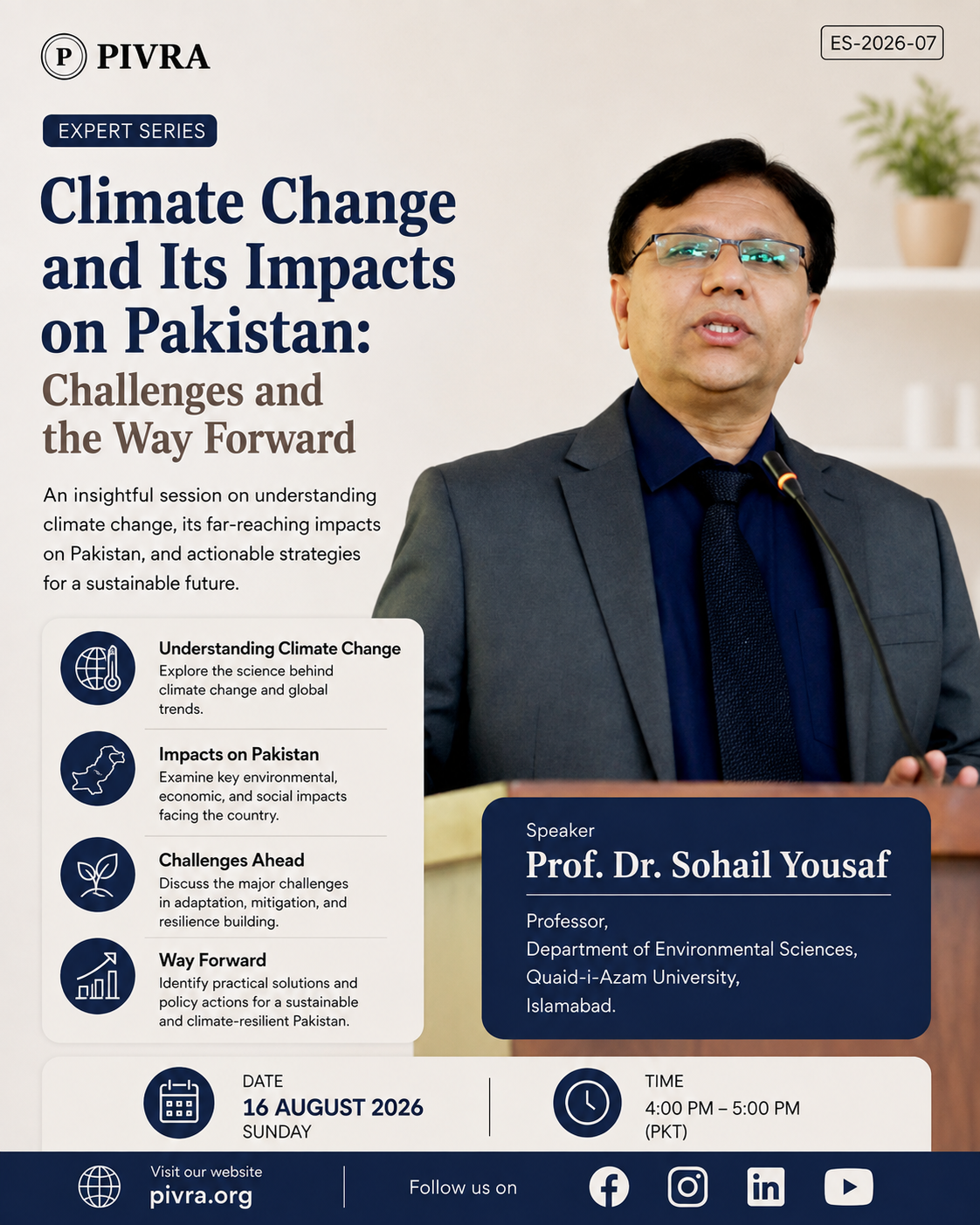
Pakistan is repeatedly ranked among the countries most vulnerable to climate change, despite contributing a small share of global greenhouse gas emissions. This session examined how climate change is already affecting the country, from glacial melt and shifting monsoon patterns to flooding, heatwaves, and pressure on water and agricultural systems, and considered the institutional, economic, and policy challenges involved in building resilience. Prof. Dr. Sohail Yousaf structured the session around the current state of the science, the sectors and regions most exposed, and the adaptation and mitigation measures under discussion at the national and provincial level.
Prof. Yousaf opened with an overview of how climate change is measurably altering Pakistan's physical environment: accelerating glacial melt in the north, an increasingly erratic monsoon, and a rising frequency of extreme heat events. He noted that Pakistan contributes less than one percent of global greenhouse gas emissions yet consistently ranks among the countries most exposed to climate impacts, a mismatch he described as the central injustice at the heart of the country's climate position internationally.
He walked through the sectors carrying the greatest exposure: agriculture, where shifting rainfall patterns and heat stress threaten yields and rural livelihoods; water resources, where glacial melt and groundwater depletion compound each other; and urban centers, where heatwaves and flash flooding increasingly strain infrastructure built for a different climate. He highlighted southern Punjab and Sindh, along with the glacial-fed river systems of the north, as the geographies where these pressures are converging fastest.
The session covered adaptation measures already under discussion at the national and provincial level, including climate-resilient crop varieties, early-warning systems for flooding and glacial lake outburst floods, and updated urban planning standards. Prof. Yousaf also discussed Pakistan's mitigation commitments and the gap between announced targets and the financing and institutional capacity needed to meet them, framing climate governance as much an institutional and financing challenge as a scientific one.
The session closed with an open Q&A, where attendees raised questions on climate financing, the role of provincial versus federal authorities in implementation, and what individuals and students can practically contribute. Prof. Yousaf closed by emphasizing that building resilience requires sustained coordination between researchers, policymakers, and communities, rather than isolated technical fixes.
This session was recorded and is available to watch on YouTube.
Watch on YouTube →