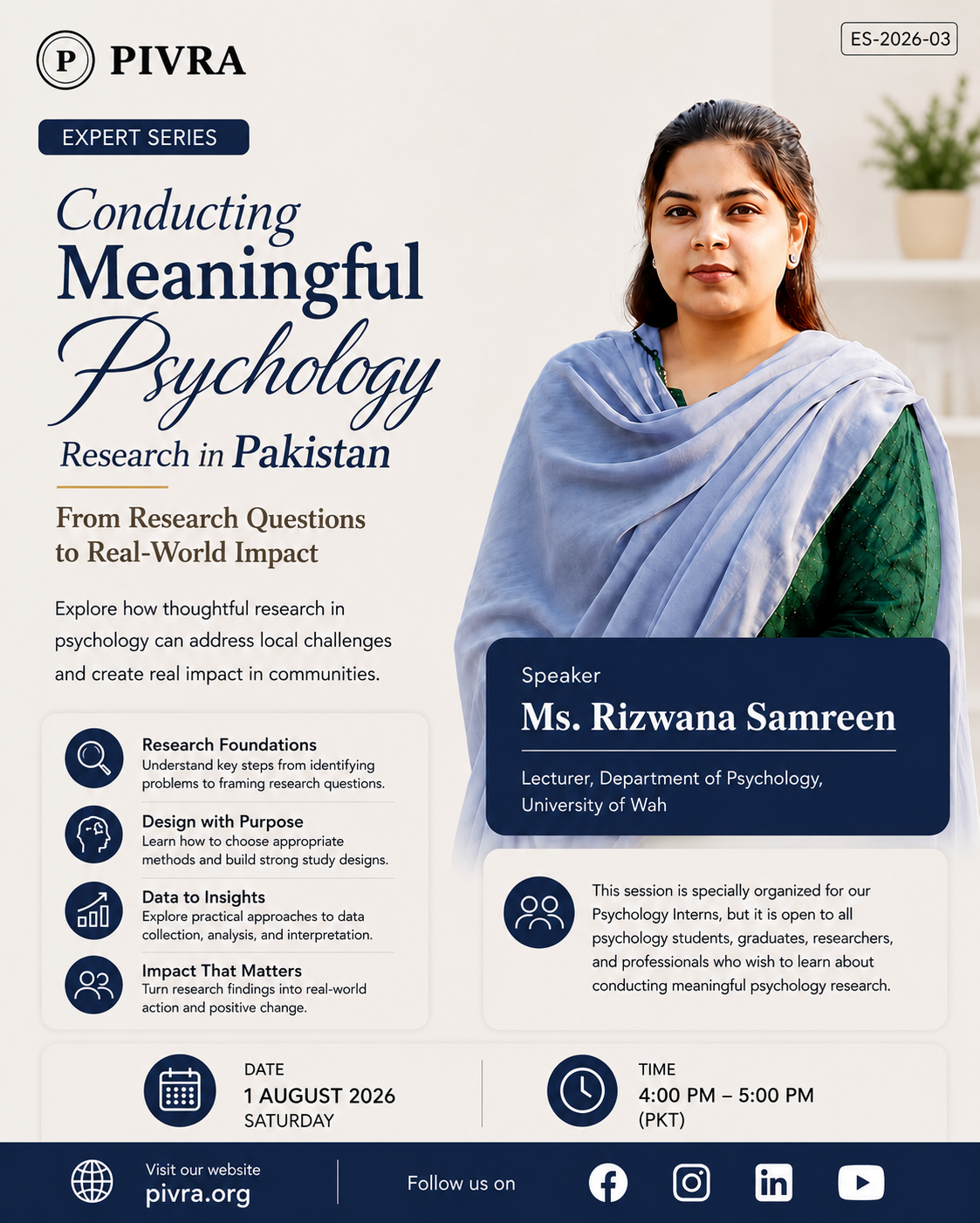
This session offered a practical roadmap for conducting psychology research that speaks to Pakistan's own context, from identifying a pressing issue through to translating findings into real-world change. Ms. Samreen structured the talk around five learning objectives: identifying pressing psychological issues that warrant research in Pakistan, formulating strong and relevant research questions, understanding common research designs, recognizing ethical considerations, and translating findings into practical recommendations for policy and practice.
Ms. Samreen opened with the scale of the problem. An estimated one in four adults in Pakistan will experience a mental health condition in their lifetime (World Health Organization, 2001), yet fewer than 500 psychiatrists serve a population of more than 240 million people (Aga Khan University Brain and Mind Institute, 2025). Youth anxiety, depression, and social-media-related stress are rising (Sajjad et al., 2025). Because so many cases go unidentified or untreated where services are limited, she framed this as fertile ground for researchers: how common these problems really are, whether people can access help, why they do or do not seek treatment, and which treatments work.
The session made the case for Pakistan-specific research on five grounds: culture shapes how distress and coping are expressed; findings and interventions from other countries do not transfer directly into Pakistan's healthcare system and resource constraints; policymakers need Pakistani data, not statistics borrowed from elsewhere, to design better services; stigma varies significantly by city, age, and community; and local research strengthens the country's own pipeline of psychologists and services.
Ms. Samreen identified six recurring gaps in the existing literature: a reliance on small, urban, convenience samples rather than representative ones; under-researched rural and marginalized populations; findings that rarely reach decision-makers in a usable format; a scarcity of longitudinal studies tracking change over time; continued use of imported psychological scales not validated for local populations; and comparatively little research on what interventions actually work, as opposed to documenting problems.
The session walked through a concrete method for narrowing a broad concern into a workable study: pinning down a specific population, a bounded context, and a measurable outcome. Using the example of anxious, burnt-out university students, Ms. Samreen demonstrated how this narrows into a focused question, such as the relationship between academic stress and anxiety among first-year university students in Lahore. She framed strong research questions against the FINER criteria, feasible, interesting, novel, ethical, and relevant, and flagged common pitfalls: questions that are too broad to answer, built on unmeasurable concepts, worded in a leading or biased way, or unrealistic given the researcher's actual time and resources.
Participants were walked through when to reach for quantitative designs (surveys, experiments, correlational studies, suited to testing relationships and generalizing findings) versus qualitative designs (interviews, focus groups, case studies, suited to rich, contextual understanding of sensitive or poorly understood topics), and when a mixed-methods approach combining both is warranted. The session also covered sampling strategies in the Pakistani context, weighing the stronger generalizability of probability sampling against the practical feasibility of convenience, purposive, or snowball sampling for student and early-career projects, alongside the steps for developing, translating, and piloting a questionnaire.
A significant part of the session addressed the ethical foundations of psychological research: securing institutional review and approval before data collection, obtaining informed consent in accessible language, and protecting confidentiality and data security. Ms. Samreen gave particular attention to vulnerable participants, minors requiring guardian consent alongside their own assent, and trauma survivors requiring extra sensitivity in how questions are worded, and stressed having a safe referral pathway ready before fieldwork begins, not improvised during a crisis. She also named the practical challenges researchers face in the field: reaching rural or conflict-affected areas safely, translating and validating tools across languages and literacy levels, building enough trust to discuss sensitive experiences, and working around limited internet infrastructure.
The session closed by mapping an impact chain: publishing through peer-reviewed journals and conferences to build a local evidence base; translating findings into short, actionable policy briefs that lead with implications rather than method; using findings to design and pilot community, school, or clinical interventions in partnership with the communities they serve; and communicating findings publicly through media and plain-language summaries to reach audiences beyond academia and reduce stigma. The session ended with an open discussion prompt: if given six months and adequate resources, what psychology problem in Pakistan would participants choose to research, and why.
The session was organized specially for PIVRA's psychology interns, and was open to all psychology students, graduates, researchers, and professionals interested in strengthening how they approach research design and real-world application.
See the full Expert Series schedule, including completed and upcoming sessions.
Back to Expert Series