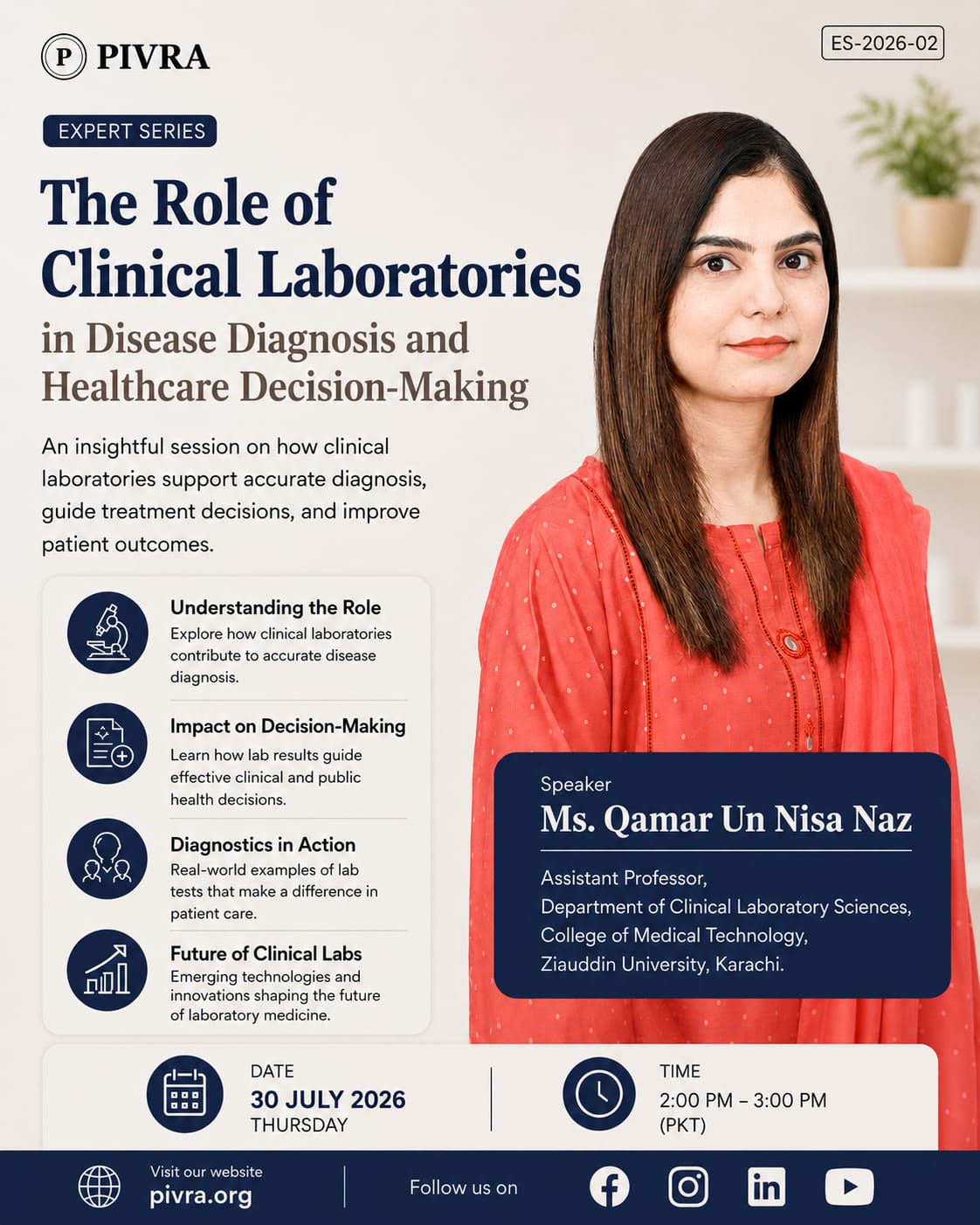
This session examined how clinical laboratories function inside modern healthcare, and how much of clinical decision-making ultimately depends on laboratory results. Ms. Naz opened by asking the audience to consider how many clinical decisions actually depend on laboratory findings, whether that is confirming a diagnosis, guiding an intervention, or shaping a treatment plan. Laboratory testing is crucial to disease diagnosis, monitoring, and management, and provides the evidence healthcare providers need to make accurate, timely diagnoses and better-informed treatment decisions.
The session was built around six objectives: defining the role and functions of clinical laboratories in modern healthcare; explaining the importance of laboratory testing in disease diagnosis, monitoring, and prevention; describing the different types of clinical laboratory tests and diagnostic techniques used in practice; discussing how laboratory findings support evidence-based healthcare decision-making and patient management; recognizing the importance of quality assurance, accuracy, and reliability in laboratory testing; and identifying the emerging technologies, challenges, and future trends shaping clinical laboratory medicine.
A clinical laboratory analyzes biological specimens, including blood, urine, tissue, and other body fluids, to detect disease, monitor therapy, and support prevention. The session distinguished between the different kinds of laboratories in the healthcare system: reference laboratories, hospital laboratories, public health laboratories, point-of-care laboratories, and research laboratories, each suited to a different purpose, scale, and turnaround time. Ms. Naz also walked through the laboratory workflow, the sequence a sample follows from collection through processing to a reported result.
Laboratories support accurate diagnosis, disease monitoring, screening, risk assessment, treatment monitoring, and prognosis. In diagnosis specifically, common tests include blood tests such as the complete blood count (CBC) used to detect anemia, biochemistry tests such as glucose testing used for diabetes, urinalysis used to assess kidney disease, microbiology cultures used to identify pathogens, and immunology tests such as ELISA used to detect antibodies. More specialized diagnostic tests include molecular techniques such as PCR, used to detect DNA or RNA, and genetic techniques such as next-generation sequencing (NGS), used in personalized medicine.
The session grouped laboratory testing techniques into four broad categories: molecular techniques such as PCR, RT-PCR, and NGS; immunological techniques such as ELISA, lateral flow tests, and antigen-antibody testing; biochemical techniques covering enzymes and biomarkers; and microbiological techniques covering culture, sensitivity testing, and molecular identification of pathogens. These techniques are distributed across the different departments that make up a clinical laboratory, and were illustrated in the session through real clinical case examples showing how test results translate into clinical decisions.
A significant part of the session focused on what it takes to trust a laboratory result. Ms. Naz covered quality assurance and accreditation practices, including internal quality control, and explained the three categories of factors that can affect the accuracy of a result: pre-analytical factors such as using the wrong collection tube, hemolysis, or delays in processing; analytical factors such as instrument error, reagent quality, or calibration; and post-analytical factors such as reporting errors, misinterpretation, or breakdowns in communication.
The session closed by looking at where clinical laboratory medicine is heading and what stands in the way. Emerging technologies discussed included artificial intelligence, automation, robotics, digital pathology, molecular diagnostics, next-generation sequencing, point-of-care testing, big data, and personalized medicine. Against this, Ms. Naz was direct about the challenges the field still faces: false positives and false negatives, cost, accessibility, workforce shortages, standardization, turnaround time, and testing errors.
See the full Expert Series schedule, including completed and upcoming sessions.
Back to Expert Series