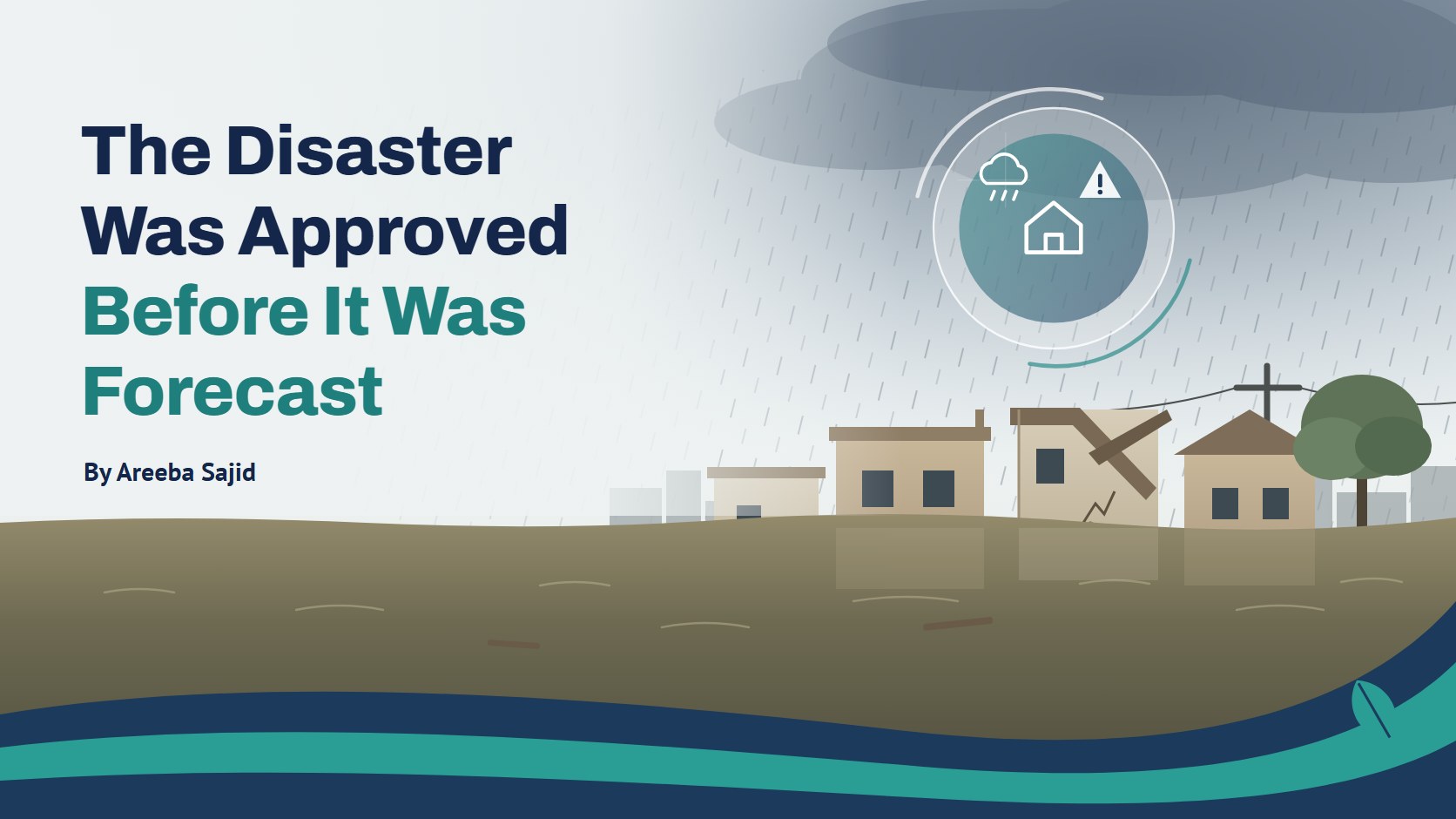
Pakistan is once again facing floods. Not again, as in another disaster hitting from nowhere, but again, as in the fourth time in less than five years: 2022, 2023, 2025, and now, mid-2026, with the peak of the monsoon still to come. More than 100 people have already been killed since the end of June, including over 50 who were not swept away by the rushing water, but were buried under the roofs of their own homes. So far, Khyber Pakhtunkhwa and Punjab are the worst hit. The heaviest rainfall of the year, in August and September, has not yet begun.
The script should now be memorized. Cities unprepared for a cloudburst are soon underwater. Rivers are expected to rise above warning levels. Alerts are issued by the National Disaster Management Authority. Relief camps go up. Authorities walk around flood-affected areas in wet shoes. As the water recedes, so does the news cycle, and so will the structures that changed prior to the next monsoon.
This is no ordinary weather story. Monsoons have always been present in Pakistan, and climate change has definitely made them unpredictable and intense. Irregular rainfall will become a mass-casualty event only when drainage systems are poor, floodplains have been filled in, and buildings are unable to endure continued flooding. Of these deaths, over half have been caused by house collapses and roof collapses, deaths which are almost unrelated to rainfall and completely dependent on the quality of the house and roof that nobody is enforcing.
It does make a difference, since it alters the responsibility. A cloudburst is a natural event. When a house comes down on the heads of people, it is more often than not the result of a decision: to build without a permit, to forget to support the structure to save money, to accept that the settlement is on a floodplain on which everyone in the local administration knew not to build. What is happening is that low income families are being pushed into the land that is most at risk from flooding, the only place they can afford to live. Building regulations exist in all provinces. But consistently, there is no one with the authority and the will to enforce them, not to mention to document the damage done after the monsoon.
The numbers tell the same story. Over a thousand people lost their lives and the country lost more than forty billion dollars due to the 2022 floods. But before the rebuilding was even finished, the 2023 floods hit. Then in 2025, more than a thousand more died. Huge amounts of money are spent every time a flood occurs in Pakistan to rebuild what has broken. This could have been used to prevent the damage in the first place: adequate drainage, preventing development in flood-prone areas, and ensuring that warnings are received in time so they can get to safety. The country is spending money on clean-up after the disaster, over and over again, rather than preventing it in the first place.
No new institutions need to be created to get any of this done. There are already NDMA and provincial counterparts. What we lack is the ordinary middle level of government, the local building inspector who shows up on site before issuing a building permit, the municipal authority that removes illegal, blocking drainage from natural drainage channels instead of turning a blind eye, the provincial government that treats floodplain maps as rules, not decoration. Disaster response in Pakistan is reasonably well organized. Disaster prevention is not, in that it doesn't require a ribbon cutting ceremony or flashy videos, it requires only that a flood did not take anyone's life.
The process is repeated annually. Warnings of rising river and heavy rain are made well in advance of the flood by the Meteorological Department and NDMA. However, a warning is not the same as an evacuation, and a forecast is not very significant to a family with no other place to go. This is the gap between warning and action. Early warning systems are effective only when the people have the means to respond. That is exactly what is forgotten in the quiet years between floods, when the risk seems far away and money is allocated to other projects.
Pakistan will not hold up the monsoon, and it should not pretend each flood is an unexpected catastrophe. The 2026 season is not over. The next weeks could be even worse, if the current five-year trend persists. The honest accounting this country has to make is not another round of "felt sorry for the folks who were displaced" but an accounting, before the next flood, of those who approved the illegal building, those who didn't pay attention to the floodplain map, and those who will be held responsible for the illegal construction.
Reach out and the editorial team will take it from there.
publications@pivra.org